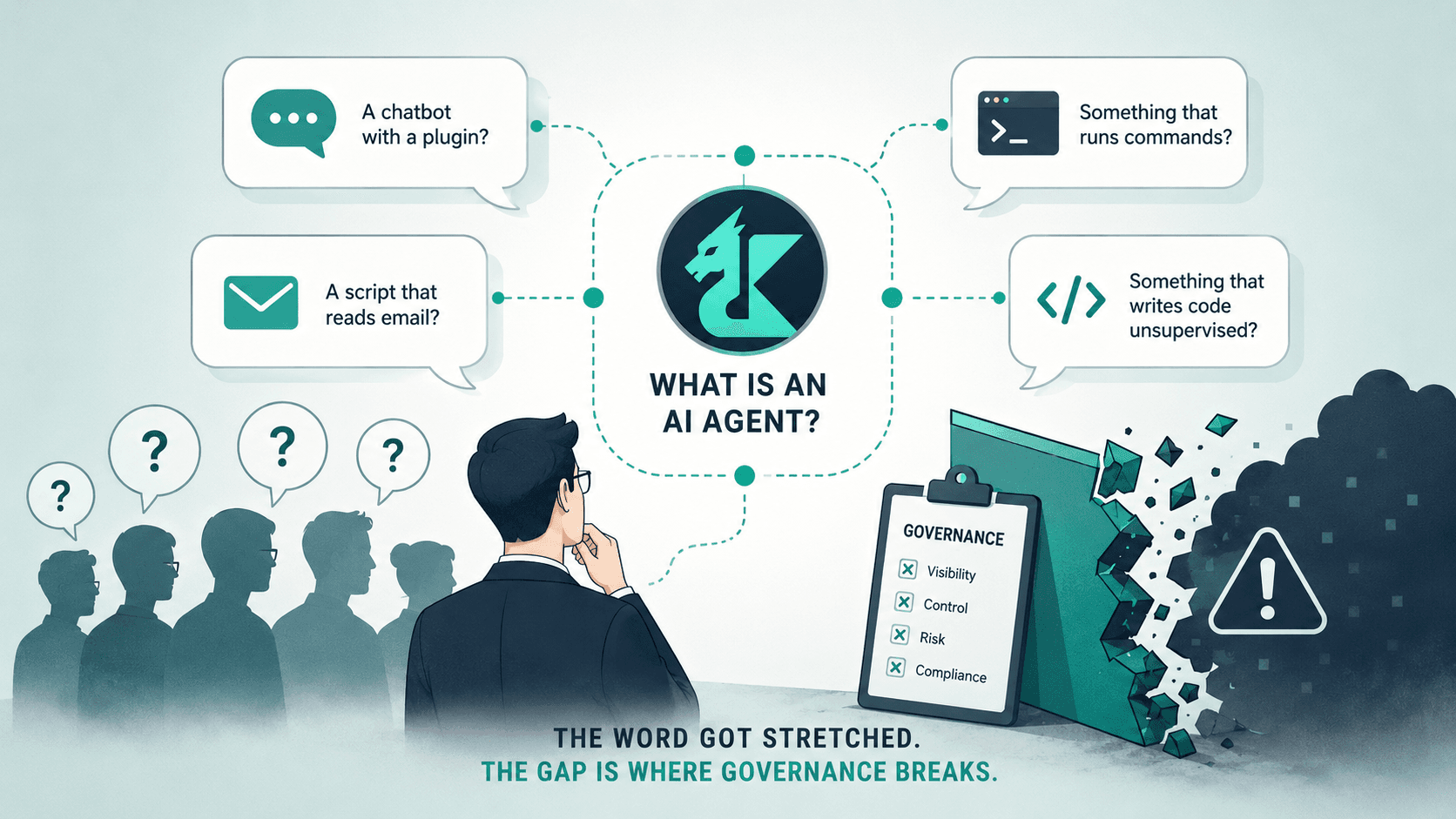
Ask five people in your company what an AI agent is and you'll get five different answers. A chatbot with a plugin. A script that reads your inbox. Something that writes code unsupervised. All five people are partly right, which is the actual problem.
The word got stretched
"Agent" has a real technical meaning that predates the current AI cycle by decades. It comes from Russell and Norvig's 1995 textbook definition, which describes an agent as anything that can be viewed as perceiving its environment through sensors and acting upon that environment through effectors. Anthropic anchors its own definition of agents to that same source.
A more practical version of the same idea, also cited by Anthropic and widely used by developers, comes from Simon Willison: an agent is a system that runs tools in a loop to achieve a goal.
Both definitions agree on the same core shape. Not a chatbot that answers a question and stops. Not a script that runs once on a schedule. A system that decides, acts, observes the result, and decides again, on its own, until a goal is met or it gives up.
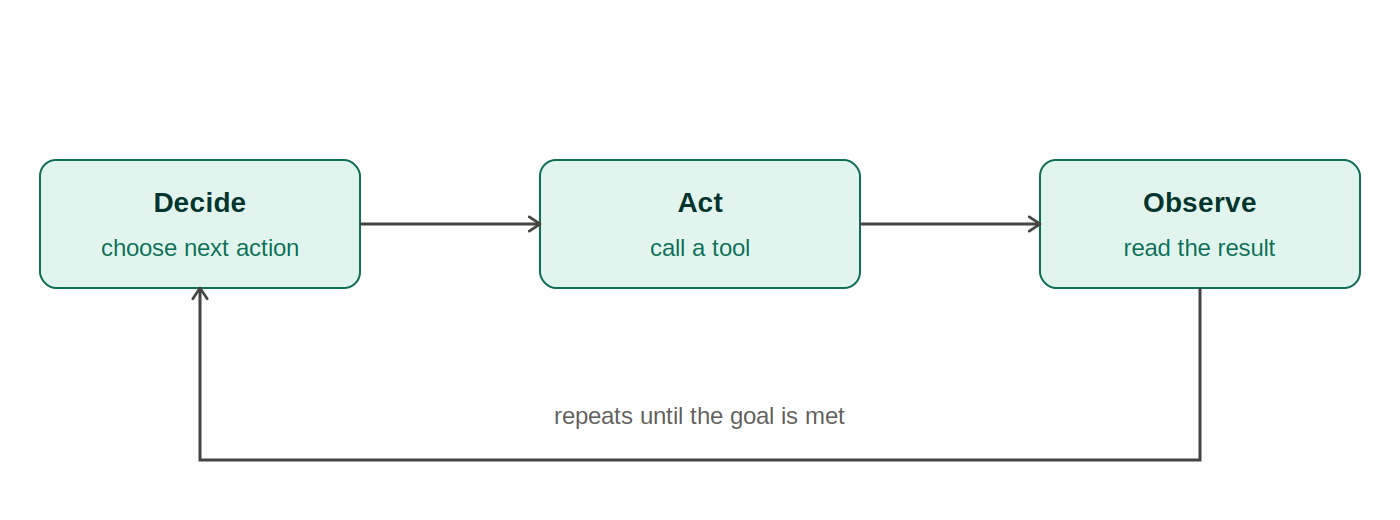
That loop, not the branding, is what separates an agent from everything that came before it.
So is an agent a bot?
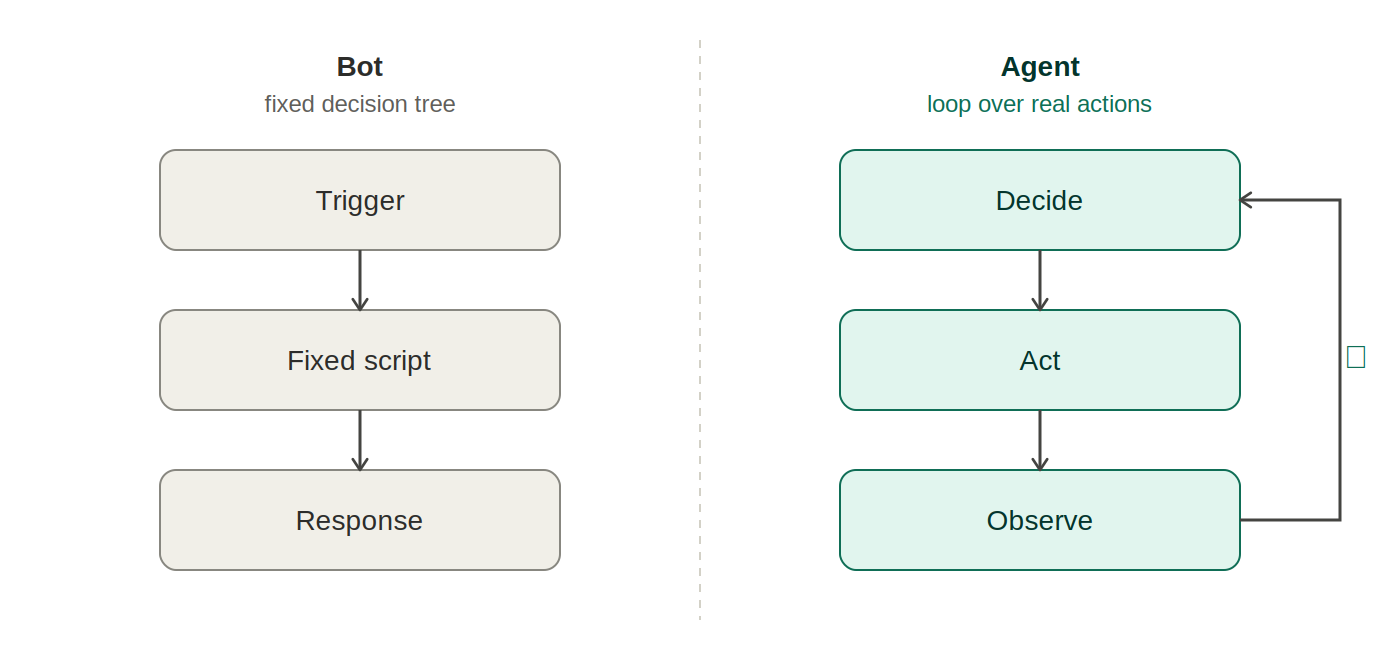
No, not in the sense most people mean when they say "bot." A classic scripted bot, a customer service bot, an IRC bot, follows a fixed path from trigger to response. Ask it something outside the script and it fails predictably. Some bots are more sophisticated than that, and "bot" is a broad word, but the useful distinction is behavioral: does the system merely execute predefined branches, or does it choose actions, observe results, and keep pursuing a goal?
An agent decides. It picks the next action itself, based on what just happened, without a human writing out every branch in advance. That's a difference in kind, not degree. A bot with more branches is still a bot. A system running the decide-act-observe loop against real tools is something else, regardless of how simple the underlying model is.
Is an agent software? In the current AI product context, yes. The confusion people run into isn't about what an agent is made of. It's about how much autonomy that software actually has, and that's a different question entirely.
The noun and the property are not the same thing
This is the distinction that resolves most of the confusion: "AI agent" is a noun, a specific software system. "Agentic" is a property, a measure of how autonomously that system can act. A given AI agent has some level of agenticness, and that level varies enormously between products that all use the same word to describe themselves.
A system that makes one tool call and returns an answer is really just tool use. It only becomes meaningfully agentic when it can choose actions, observe the results, and continue the loop without each branch being prewritten. A system that plans a multi-day project, delegates subtasks to other agents, and only checks in with a human at the end is deeply agentic. Both ends of that range get marketed as "AI agents." Only one of them should be trusted with production credentials without a second look.
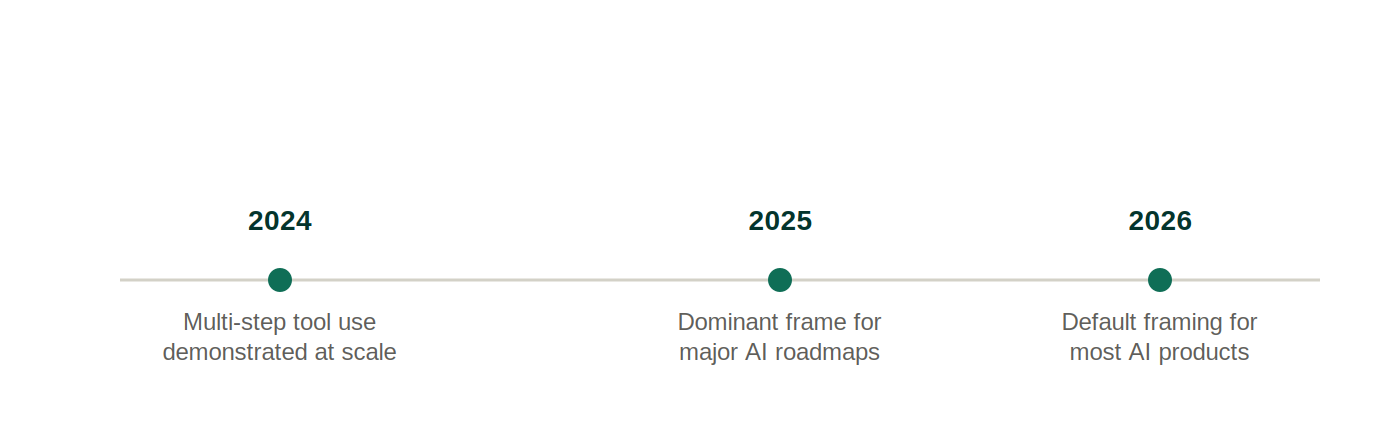
The modern agent wave started in 2023, when ChatGPT plugins, AutoGPT, BabyAGI, and similar projects made multi-step tool use visible to a much wider developer audience. Through 2024 and 2025, "agentic" became a standard framing across AI product roadmaps at OpenAI, Anthropic, Google, and Microsoft. By 2026, describing a product as agentic is close to the default, which is exactly why the word stopped being a useful filter on its own. When almost everything claims the label, the label stops telling you anything about what the system actually does.
The autonomy underneath the word is real, and growing
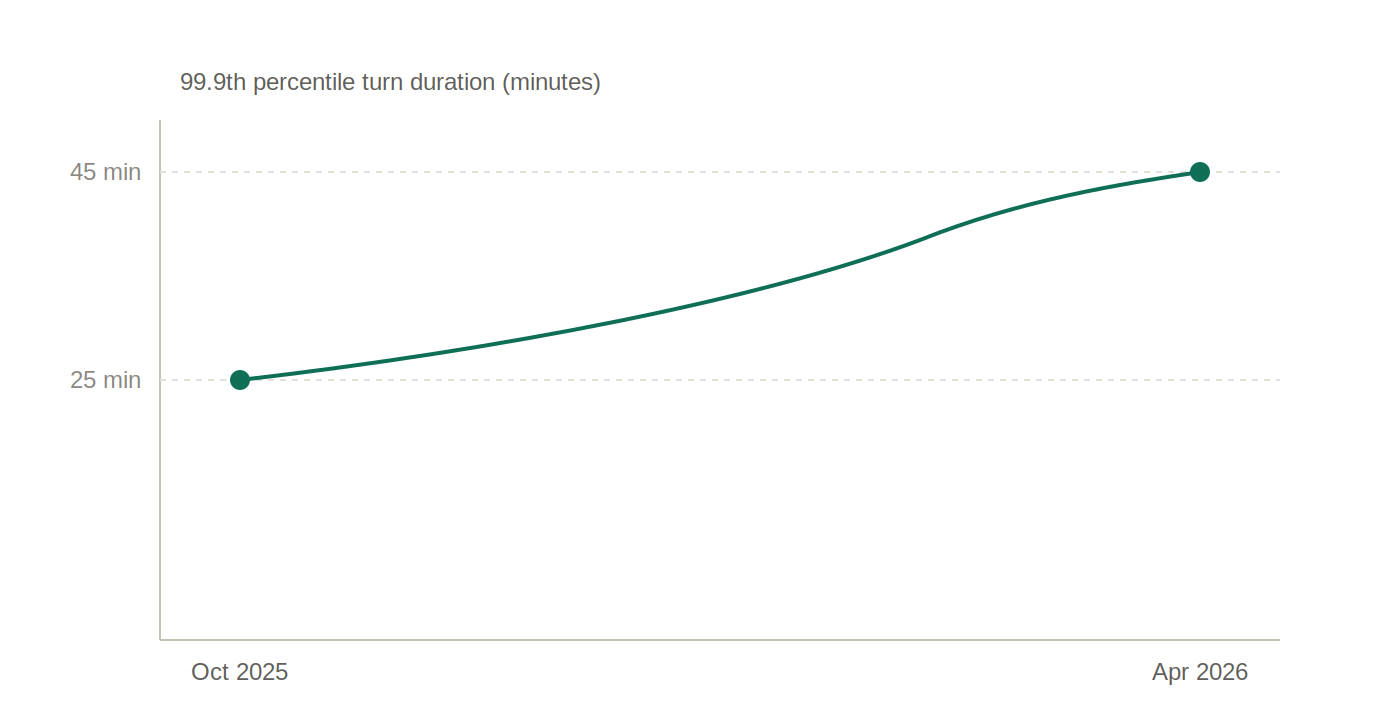
The marketing stretch doesn't mean the underlying capability is fake. Anthropic has published two useful data points here. In its February 2026 autonomy report, Anthropic found that the 99.9th percentile Claude Code turn duration, essentially how long the agent kept working autonomously on a single turn before checking back in, nearly doubled between late September and October 2025 and early January 2026, rising from under 25 minutes to over 45 minutes. Anthropic noted the increase was smooth across model releases, suggesting the change was not only a model-capability jump but also reflected growing user trust, more ambitious tasks, and product improvements. The same report cautioned that turn duration is an imperfect proxy for autonomy, and that the extreme tail declined somewhat after mid-January.
Separately, in June 2026, Anthropic analyzed roughly 400,000 interactive Claude Code sessions from about 235,000 people between October 2025 and April 2026. That later report focused less on raw autonomy duration and more on how people actually use Claude Code, including the division of labor between human planning and agent execution.
That's the part worth sitting with. The word "agent" may be overused, but the actual behavior it sometimes describes, a system running unsupervised for the better part of an hour, making its own sequence of decisions against real infrastructure, is not hype. It's already happening, with the most autonomous runs now measured in tens of minutes rather than seconds.
Why the definition gap is now a governance problem
Here is the part that doesn't show up in most explainers. If your organization can't agree on what counts as "an agent" running against your systems, you can't write a policy that governs it, and you can't reconstruct what happened after the fact.
A policy written against the marketing term collapses the moment someone points out that their tool is "just an assistant" or "just automation," even when it's running the exact same decide-act-observe loop against the exact same production database. The fix isn't a better definition of "agent." It's writing policy against the behavior itself: does this system run a loop, call tools, and act without a human confirming each step. If yes, it gets governed the same way regardless of what the vendor calls it.
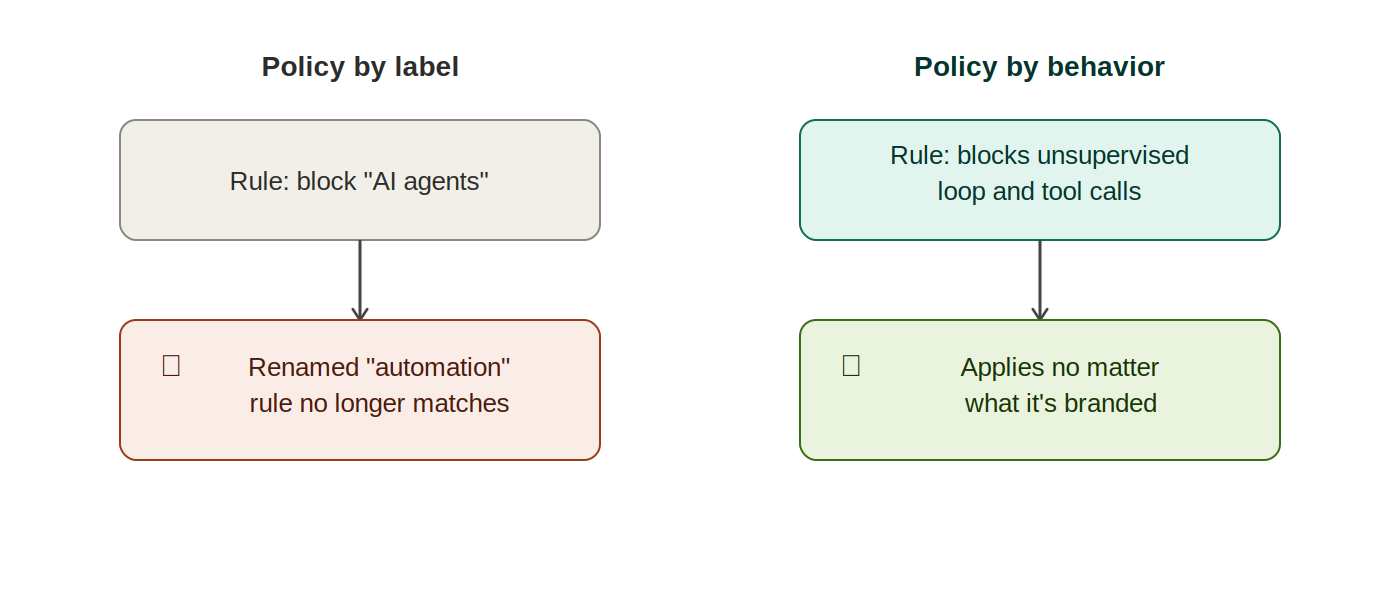
That's also the only definition that holds up to an audit. Six months from now, when something goes wrong and someone asks "was that an agent," the honest answer has to come from a log of what the system actually did, not from what it was marketed as.
The short version
- An agent is software that decides, acts, and observes in a loop to reach a goal, not a chatbot and not a fixed script.
- "Agent" is the noun. "Agentic" is a spectrum describing how much of that loop runs without a human in it.
- The word got stretched by marketing pressure between 2023 and 2026, to the point where it's a weak filter on its own.
- The autonomy the word originally described is real and, by Anthropic's own usage data, still growing.
- Governance has to be written against what a system does, not against whether it calls itself an agent.
The next time someone in your org says "it's not really an agent, it's just automation," ask what it actually does. If it runs a loop and calls tools without a human approving each step, the label doesn't matter. The policy should apply anyway.
See how KonaSense governs agents by behavior, not by label