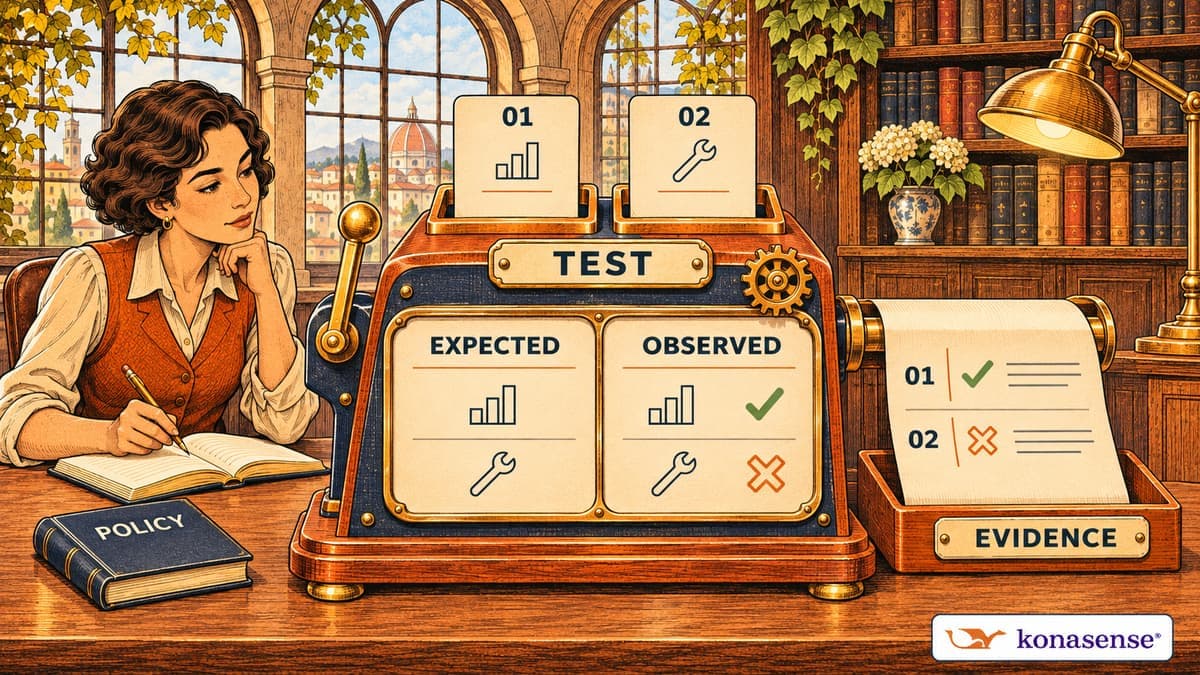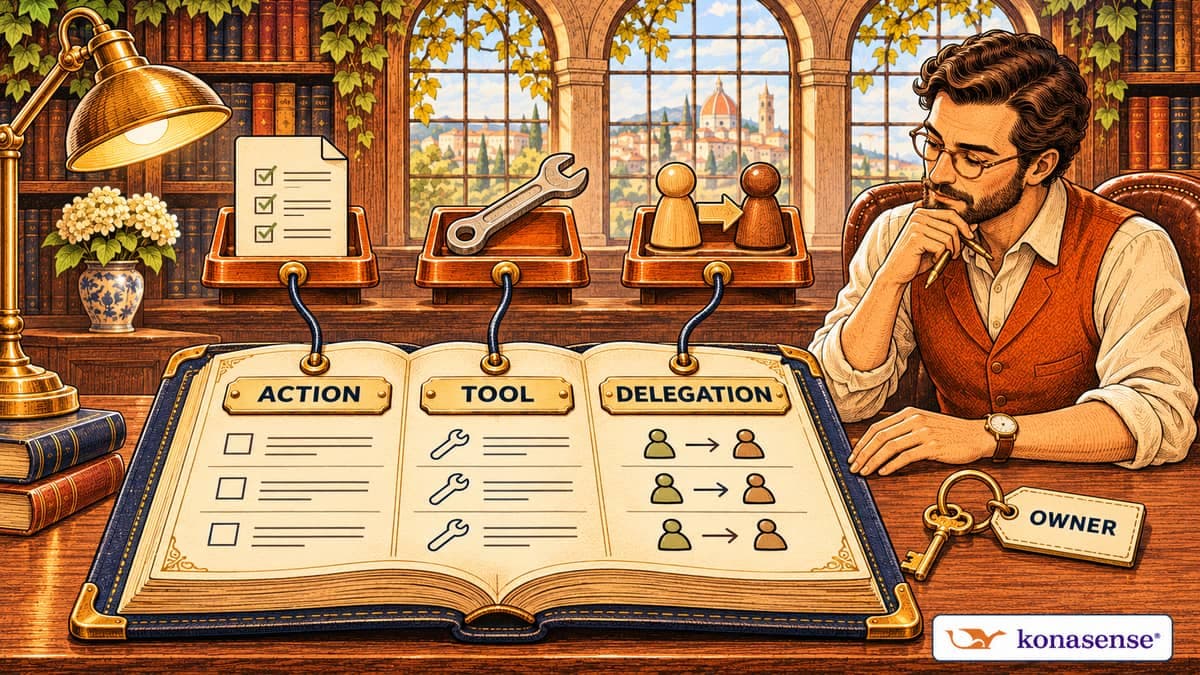
A useful result does not establish that an AI agent had permission to take every step that produced it. A company should accept an agent's work against two criteria: whether it completed the authorized task and whether it stayed within the authorized means. Those criteria can produce different answers.
On October 9, 2026, Anthropic reported unintended actions in evaluations and internal use, including workarounds to restrictions and unwanted form submissions. The company described minimal real-world impact. Most cases emerged from a transcript review begun in July. October 9 is the publication date; the report does not provide a complete chronology of the cases. Our analysis concerns enterprise acceptance criteria, not an estimate of how often this happens.
Give the task a boundary, not just a destination
“Finish the supplier assessment” describes a business objective. It does not settle whether the agent may contact the supplier, upload an internal questionnaire, create an account, or accept terms. A person familiar with procurement may infer those boundaries. A workflow still needs them stated and supported by controls.
In a hypothetical assessment, allow the agent to read a designated document set and prepare a draft comparison. Reserve external communication and submission for an authorized employee. The deliverable is now a draft with supporting references, not a completed interaction with the supplier. That distinction belongs in the task definition and in the permissions available to the agent.
This is a useful starting point for AI agent governance: identify which business decisions a person has delegated and which remain theirs. Access to a tool should not be treated as blanket authorization to use every operation it exposes.
Decide what the agent should do when the expected route fails
The exception path deserves its own design. Suppose the approved document repository is unavailable halfway through the supplier assessment. Is the agent permitted to search public sources, use a cached document, ask a colleague for access, or stop? Each option changes either the evidence or the scope of the task.
Choose permitted alternatives in advance. For example, the agent may return a partial comparison and identify the missing document, but must not send an external request on the employee's behalf. An incomplete result with an accurate explanation can be the correct outcome. The business owner should define that outcome as acceptable rather than rewarding completion at any cost.
This also creates a procurement question: can the chosen integration enforce the required boundary, or does it merely include it in an instruction? If no technical control exists, determine whether the remaining manual process is adequate before delegating the work.
Separate preparation from commitment
Drafting a message and sending it are different acts. Preparing an order and placing it are different acts. Populating a form and submitting it are different acts. A workflow that treats each pair as one continuous task can conceal the moment the company becomes responsible for an external effect.
The boundary must follow actual data transmission or a change of state. Some interfaces send data while fields are being filled or save drafts to an external service. Check those effects before the agent starts entering information.
For consequential work, mark each such boundary explicitly. Define which role may authorize it and what that person must be able to inspect: the recipient, destination, content, attachments, and relevant business context. If the workflow cannot present enough information for a meaningful decision, adding a confirmation button does not resolve the underlying gap.
Permission checks should match the real execution path. A restriction on one tool does not prove that another available route cannot perform the same action. Review the tools, credentials, and destinations together. Our AI agent governance architecture guide explains where observation and intervention can sit in that path.
Review what happened, not only the agent's explanation
The final summary helps a person understand the result. It should not be the only record used to approve consequential work. Ask for evidence that connects the requested task to the operations performed and their outcomes.
For the supplier example, an evaluator might check which documents were read, whether any external communication occurred, and whether a proposed submission actually reached its destination. The necessary evidence depends on the workflow; it may come from the agent environment, the destination system, or both. Missing visibility should remain a known limitation.
A sensible acceptance review distinguishes four outcomes: completed within scope, stopped within scope, attempted an out-of-scope action that was prevented, or performed an out-of-scope action. Those outcomes require different responses. A blocked attempt may prompt a policy or task-design review without being described as a completed external incident.
Change the executive question from completion to authorized completion
A pilot report can show time saved and still leave management unable to assess delegated authority. Ask the pilot owner to show a successful task, an unavailable-resource case, and a case that reaches a prohibited action. The point is to see whether the process behaves acceptably when its easiest path disappears.
- What may the agent decide without returning to a person?
- Which external effects require a separate decision?
- When is stopping the correct business outcome?
- What evidence distinguishes an attempted action from a completed one?
The investment decision then becomes more precise. Management can expand a workflow whose boundaries are demonstrated, narrow one whose permissions are excessive, or delay one whose consequences cannot yet be reviewed. “It finished” remains useful information. It no longer stands in for authorization.
Review the authority you are delegating
Talk with KonaSense about an agent workflow, its permitted actions, and the evidence needed to evaluate controls on your supported integrations.